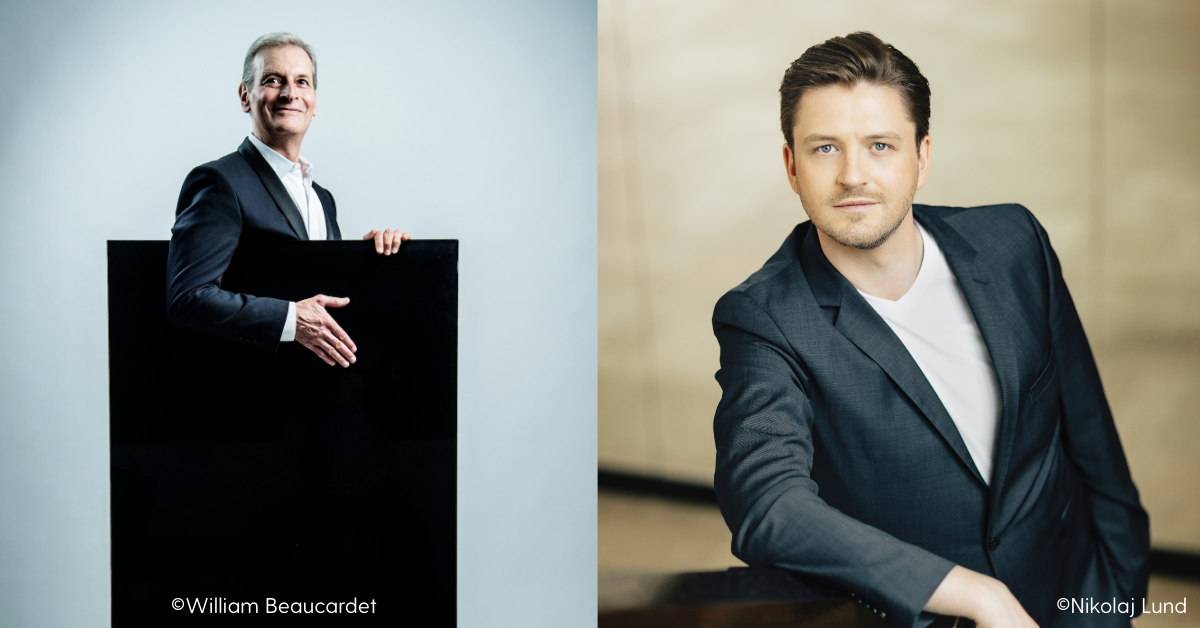
Samuel Hasselhorn, baritone & Philippe Bianconi, piano
: *Winter Journey*
- Tuesday, June 30, 8:00 p.m.
- Domaine Pommery, Salle Louise, Reims
Samuel Hasselhorn, baritone
Philippe Bianconi, piano
A major repertoire cycle, featuring voice and piano in an exceptional setting.
Biography of Samuel Hasselhorn
Born in Göttingen in 1990, Samuel Hasselhorn is now one of the most influential performers of his generation. After studying in Hanover and Paris, and winning prestigious competitions—notably the Queen Elisabeth Competition in 2018—he has established himself on the international stage, both in opera and in the fields of recital and concert performance.
As an opera singer, Samuel Hasselhorn was first a member of the Vienna State Opera company, then of the Nuremberg State Opera. He now performs regularly at major opera houses, such as the Staatsoper Unter den Linden in Berlin, the Frankfurt Opera, the Deutsche Oper Berlin, and La Scala in Milan. During the 2025/26 season, he will make his debut at the Gran Teatre del Liceu in Barcelona in a new production of Mozart’s The Marriage of Figaro, in the role of Count Almaviva, as well as at the Baden-Baden Easter Festival as Heerrufer (Lohengrin), under the baton of Joana Mallwitz. He will also return to the Staatsoper Unter den Linden under the baton of Christian Thielemann, in the role of the Barber Schneidebart in *Die schweigsame Frau*, as well as for the world premiere of *Das kalte Herz* by Matthias Pintscher and for concerts featuring Brahms’s *Requiem*, which he will also perform in a staged version at the Opéra de Rouen.
Alongside his opera career, Samuel Hasselhorn is passionately dedicated to the art of the Lied. One of his major projects is the “Schubert 200” series, in which he is recording, alongside pianist Ammiel Bushakevitz, Lieder by Franz Schubert for the Harmonia Mundi label through 2028—each composed exactly two hundred years ago. The first two albums, *Die schöne Müllerin* and *Licht und Schatten*, were awarded a Diapason d’Or of the Year as well as the German Record Critics’ Award. He also excels in the orchestral repertoire: his symphonic album Urlicht – Songs of Death and Resurrection, recorded with the Poznań Philharmonic Orchestra under the baton of Łukasz Borowicz, was released in the summer of 2024 and won both the Best Vocal Album and Recording of the Year awards at the International Classical Music Awards (ICMA).
His concerts and recitals have taken him to prestigious venues such as Wigmore Hall, the Pierre Boulez Saal in Berlin, with the Royal Liverpool Philharmonic Orchestra, at the Teatro del Maggio Musicale Fiorentino, the Schubertiade in Hohenems, the Opéra de Rouen, the Alte Oper in Frankfurt, the Elbphilharmonie in Hamburg, and the Salle Bourgie in Montreal.
Critics praise not only the clarity and warmth of his voice, but also the intensity of his interpretation of the text and his ability to convey musical drama through psychological nuances of great subtlety. Combining technical brilliance, stylistic breadth, and a strong artistic curiosity, Samuel Hasselhorn has secured a prominent place on the international stage. His career blends the classical legacy of the great baritones with a resolutely modern interpretive approach—a voice that powerfully shapes the opera and vocal art of our time.
Biography of Philippe Bianconi
From Italy, he draws his name and the passion buried deep within him—the passion that makes him come alive when he’s on stage, the passion that moves his audience. Italy sings within him through the colors of his native tongue and the Mediterranean exuberance that shaped his childhood. But it is in Nice that Philippe Bianconi was born and raised; it is France that shaped him. Thus, in both the artist and the man, there is a blend of poise and ardent passion, of discretion and inner fire, adorned with the elegance and radiance that shine through his presence and his gaze, and that are savored when he is at the piano.
As a young man, he rose rapidly through the ranks, propelled into international competitions by Pierre Cochereau immediately after graduating from the Nice Conservatory. His path was set from the day he joined Simone Delbert-Février’s class, a student of Marguerite Long and Robert Casadesus. “Sing!” “Listen!”—he still hears these commands from this refined, vibrant woman, animated by an inner fire, and he in turn passes them on to the students he teaches at the École Normale de Musique de Paris. Along his unconventional path, he met Gaby Casadesus: with her, he refined the purity of his style and the clarity of his musical expression, qualities cultivated from the very beginning of his training. Under the guidance of Russian pianist Vitalij Margulis, he discovered the unique density of sound that is his own and drew from the nuances of the text and the depths of the harmonies an expressiveness always in the service of meaning. A double triumph! First Prize at the Robert Casadesus Competition in Cleveland, followed by Second Prize at the Van Cliburn Competition; he triumphed at Carnegie Hall, launching his American career… Then came Europe, France, and the world, in recitals or alongside today’s most eminent musicians. And always in the wake of the Casadesus couple, but also of Nadia Boulanger, quite naturally, he succeeded Philippe Entremont for five years as artistic director of the American Conservatory of Fontainebleau.
At a concert, that vibration of the air—when silence fills the hall—is precious to him, liberating, and inspiring. He sometimes takes on the wildest challenges there, such as performing both of Brahms’s concertos in a single evening. When he returns to his little corner of paradise somewhere in the south between the sea and the mountains, he remembers his younger years, his parents taking him to the opera, and that love for the human voice he felt so early on and which will never leave him. He remembers Hermann Prey, whom he met at the age of twenty-two, and Schubert, who brought them together on record and for eight years on stages around the world—Wigmore Hall, La Scala, Munich, New York… And so his piano sings, breathes, becomes flesh and soul. And Chopin, Schumann, Brahms, but also his beloved French composers, Debussy and Ravel, in a sublime surrender, entrust this musician-poet with the treasures of their innermost secrets.
Source: philippebianconi.com
Practical info