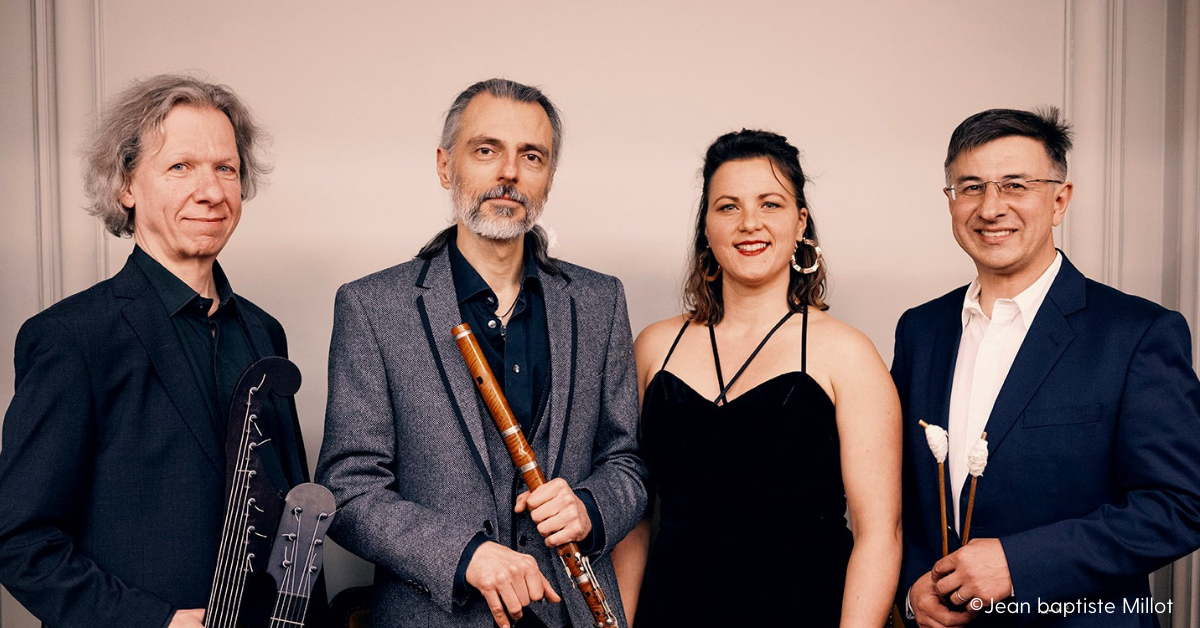
The Musicians of Saint-Julien
: On the Banks of the Beautiful Blue Danube
- Monday, July 6, 8:00 p.m.
- Hôtel de Ville, Salle des Fêtes, Reims
Musicians from Saint-Julien
François Lazarevitch, flute, frula, recorder,
bagpipes & conductor
Hélène Richaud, mezzo-soprano & cello
Iurie Morar, cimbalom
Léo Brunet, contrabass guitar, cittern
Inthe19thcentury, Vienna, the capital of the Danube Monarchy, was a cultural crossroads and a place of remarkable social diversity. Music and dance brought together people from all walks of life, from servants to aristocrats. The Danube, as a river flowing through multiple nations and cultures, symbolized both cultural diversity and unity, serving as a bridge between East and West. This cosmopolitan and popular spirit inspires the program*On the Banks of the Beautiful Blue Danube*, a true kaleidoscope of sounds from Central Europe.
This program reflects this vibrant diversity by blending popular masterpieces by Schubert, Beethoven, and Strauss with lesser-known works by Ivanovici and Hunyady, as well as traditional Hungarian, Serbian, Bosnian, and Romanian folk tunes.
Within this masterful blend, a rich palette of colors and energies unfolds. The dazzling virtuosity and ethereal lightness of the variations for the csakan—a Hungarian instrument related to the recorder, equipped with keys, and first appearing in the early19thcentury—interact with the folk-inspired spirit of numerous traditional tunes. These are carried by the lively and expressive sounds of pastoral flutes such as the Serbian frula or Romanian fluier, and supported by the virtuoso playing of the cimbalom, captivating with the finesse of its ornamentation and the vigor of its rhythmic energy.
Joining François Lazarevitch are Hélène Richaud, whose voice adapts with remarkable flexibility to both classical repertoire and the ornamentation of folk music, on vocals and cello; Iurie Morar on the cimbalom, and Éric Bellocq or Léo Brunet on the Kontraguitare—a double-necked guitar with bass strings, capable of exploring the depths of the double bass register. Also appearing in the early19thcentury, this instrument remains a living and vibrant element of Austrian folk music.
This exciting and unique program once again draws on the diverse and rare talents of the Musiciens de Saint-Julien, who, through their virtuosity and sensitivity, bring this exceptionally rich tapestry of sound to life.
The program features works by Beethoven, Schubert, Strauss, Hunyady, and Ivanovici, as well as traditional music from Hungary, Serbia, and Romania…
Biography of the ensemble
Since 2005, the ensemble Les Musiciens de Saint-Julien, led and inspired by flutist François Lazarevitch, has held a unique place in the world of early music. Conceived as a true artistic laboratory, it develops an approach that is both rigorous and intuitive, skillfully blending scholarly sources with oral traditions. The result is a musical language that is vibrant, expressive, and deeply personal, resonating with a broad and diverse audience.
Convinced that an understanding of historical styles is essential to their interpretation, Les Musiciens de Saint-Julien explore the richness and variety of the early and Baroque repertoires with both rigor and great freedom. Their solid technical foundation allows them to tackle with brilliance chamber music as well as orchestral and operatic works, as well as staged performances and programs inspired by traditional music. They perform the great works of the repertoire—Purcell’s odes, Bach’s and Mozart’s concertos, and opera arias by Vivaldi or Handel—always infused with their renewed energy.
Their discography, released on Alpha Classics and regularly praised by critics (Choc Classica, Diapason d’Or), reflects this artistic commitment that is both rigorous and open-minded; exploring a vast repertoire brought to life by performances that have become benchmarks, ranging from the air de cour to Purcell, from Bach to Vivaldi or Mozart, through the early music of Ireland and Scotland, to rare works by Marin Marais.
The ensemble performs on numerous prestigious stages, both in France and abroad, and collaborates frequently with artists from a variety of backgrounds: contemporary composers (Gérard Pesson, Benoît Menut), directors, choreographers, and singers such as Tim Mead, Hana Blažíková, and Rosemary Standley.
These fruitful exchanges continually enrich and broaden the scope of their artistic endeavors. The 2025–2026 season features several projects, including: *Aux rives du beau Danube bleu*, dedicated to the music of Central Europe and scheduled to be performed soon at the Salle Cortot, as well as at the Folles Journées festivals in Nantes, Tokyo, and Warsaw; and *The Last Rose*, a new work based on English and American ballads featuring Rosemary Standley, scheduled to be performed at Le Volcan and the Salle Gaveau…
This season will also see them perform at the Atelier Lyrique de Tourcoing, the Musicales de Normandie, the Flâneries de Reims, Actus Humanus (Poland), Styriarte (Austria), La Roque d’Anthéron, and at the Volcan – Scène nationale du Havre, their artistic home base.
Based in Le Havre, Normandy, Les Musiciens de Saint-Julien are deeply committed to sharing their art. Their Summer Academy, which brings together around a hundred musicians and dancers from around the world each year, offers an immersive experience in their unique artistic vision. At the same time, the ensemble publishes sheet music resulting from its research and shares a wealth of educational and artistic content on its YouTube channel, thereby actively contributing to the promotion of early music among all audiences.
Source: lesmusiciensdesaintjulien.com
Biography of François Lazarevitch
Having established himself as one of the most accomplished performers of his generation, François Lazarevitch was trained by pioneers of early music such as Antoine Geoffroy-Dechaume, Barthold Kuijken, and Pierre Séchet. Drawing on their teachings, he has developed a highly personal approach characterized by musical intuition and great freedom of phrasing, combined with a stylistic rigor rooted in his passion for ancient texts.
A master of all types of flutes—from the Renaissance flute to the multi-keyed Romantic instruments—he also excels at playing recorders and, more unusually, early bagpipes. He has always had a deep interest in the music of oral traditions, particularly those of central France and Ireland, which he has long been accustomed to performing, and more recently, those of Eastern Europe. This versatility shapes the identity of the ensemble he founded in 2005 and which he leads: Les Musiciens de Saint-Julien. With them, he develops original programs where oral traditions and scholarly sources intersect and coexist. This approach has led him to perform on the greatest stages in France and internationally.
Her discography with Alpha Classics fully reflects the richness of this musical world. From 17th-century court music to Mozart, via Praetorius, Bacilly, Bach, Vivaldi, Purcell, and Canteloube, this critically acclaimed discography has become a benchmark today. It would already be remarkable to offer exemplary performances of Bach’s sonatas, Telemann’s fantasias, or Mozart’s concertos, but the same holds true for 17th-century court arias, medieval music, Irish traditions, and Baroque Christmas carols. All these programs have been approached with a unique perspective, entirely inspired by her multifaceted cultural background.
“François Lazarevitch seems to possess an unparalleled instinct for understanding musical styles and revealing what no one before him had seen…” – Classica
His latest recording, a world premiere, features previously unpublished works by Marin Marais that were recently rediscovered, allowing us to rediscover them on the flute.
As a conductor, he leads a repertoire ranging from Baroque opera (Handel, Purcell, Vivaldi) to concertos (Bach, Telemann), working with international soloists such as Tim Mead, Julie Roset, and Hana Blažíková… He is also involved in the rediscovery of forgotten repertoires and published a translation of Giuseppe Tartini’s treatise on ornamentation in 2023.
A curious and socially engaged artist, he maintains close ties with the contemporary arts scene by commissioning works from composers such as Gérard Pesson, Philippe Hersant, Vincent Bouchot (Trilogue ou l’Art de la conversation, 2020), and Benoît Menut (La Quête de Merlin, 2024), and regularly collaborates with directors and choreographers.
A passionate collector, he collects instruments for their beauty, their history, and their unique tonal qualities.
He teaches the baroque flute and the musette at the Versailles Conservatory, is an associate artist at the Le Havre Conservatory, and directs the Académie des Musiciens de Saint-Julien. He regularly gives master classes and lectures in France and abroad (Geneva, Salzburg, Prague, London, Moscow, McGill University…) and shares his expertise via the ensemble’s YouTube channel with his Petit traité d’interprétation.
François Lazarevitch is a Knight of the Order of Arts and Letters.
Source: lesmusiciensdesaintjulien.com
Practical info