- Home
- Happy Strolls 25/26
- Léon Haffner, violin / Karen Kuronuma, piano
Léon Haffner, violin / Karen Kuronuma, piano
, Happy Flâneries
- Thursday, January 8, 6:30 p.m.
- Villa Douce, Reims
Léon Haffner and his collaborator Karen Kuronuma present a program that spans three fundamental styles of the violin-and-piano repertoire, from the late Classical period to the Romantic and post-Romantic exuberance of the turn of the 20th century.
Mozart’s Sonata for Violin and Piano in E-flat Major, K.302, belongs to the cycle of so-called “Palatine” sonatas, composed in 1778 during the composer’s stay in Mannheim. These works mark an important stage in the evolution of the sonata for violin and keyboard: the violin, previously confined mainly to an accompanying role, acquires true thematic autonomy. In K.302, structured in only two movements, Mozart displays a style of great clarity, drawing on the galant aesthetic yet already marked by formal maturity. The instrumental dialogue is based on a balanced distribution of roles, in which the violin line sometimes takes on an almost vocal character, supported by a piano with harmonically refined contours.
WithWieniawski’s Brilliant Fantasy on Themes fromFaust, the program fully immerses itself in virtuosic Romanticism. Composed in 1865, this work follows the tradition of opera paraphrases, which were very much in vogue at the time. Wieniawski, himself a brilliant violinist and composer with an intensely idiomatic style, exploits the full expressive and technical range of the instrument: dizzying double stops, passages in harmonics, and cantabile phrasing of great amplitude. The themes borrowed from Gounod’s opera take on a concertante dimension here, where virtuosity transcends mere dramatic illustration to become true violin poetry.
Finally, the Grieg’s Violin Sonata No. 3 in C minor, Op. 45 (1886–87) concludes this first installment of Happy Flâneries 2026 with a denser, more introspective style. The composer’s final contribution to the genre, it stands out for its formal scope and bold harmonic language, marked by the combined influences of late Romanticism and Norwegian folklore. The tension of the first movement, built on concise yet strongly defined motifs, finds a counterpoint in the almost pastoral lyricism of the central movement, before the finale unites rhythmic energy and dramatic power. This sonata, darker and more ambitious than the Norwegian composer’s two previous ones, bears witness to a process of integration between European tradition and national idiom, within a deeply personal idiom.
A concert that will shed light on the evolution of the violin-and-piano sonata genre and the many ways in which composers have explored the relationship between virtuosity, expressiveness, and musical structure.
Biography of Léon Haffner
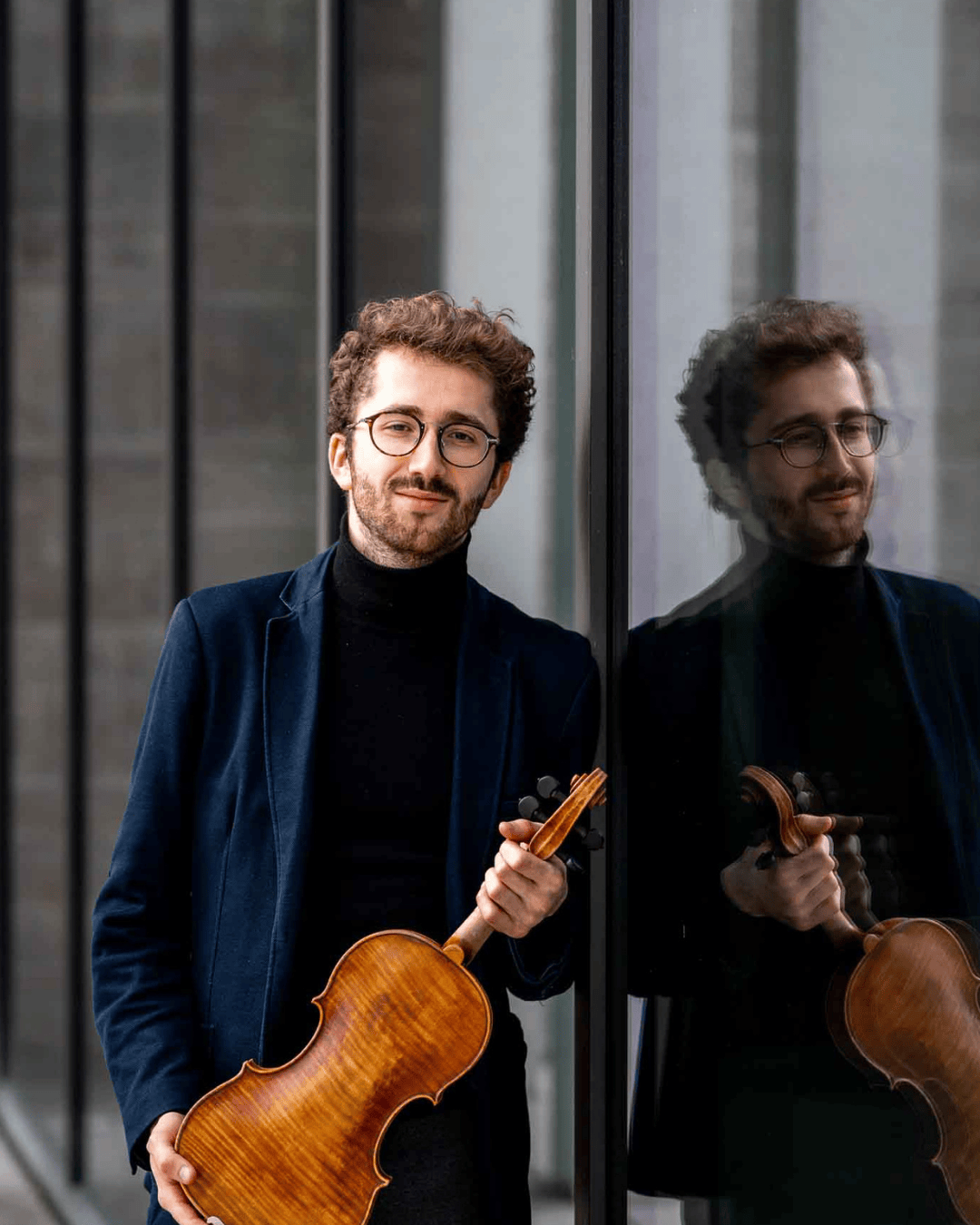
A graduate of the Paris Conservatory (CNSM) and the Hanns Eisler Academy of Music in Berlin, Léon Haffner began studying violin at the Regional Conservatory of Lyon (CRR), where he earned his DEM. He was subsequently admitted unanimously to the Paris Conservatory (CNSM) to study under Alexis Galperine, and in 2019 to the Hanns Eisler Academy of Music in Berlin to study under Ulf Wallin.
Passionate about chamber music, at the age of 18 he became concertmaster of the French Youth Orchestra (2017–2018), then joined the European Union Youth Orchestra and the Mahler Chamber Orchestra Academy. He honed his skills in string quartet performance by participating in the Seiji Ozawa (Rolle, Switzerland) and Nume (Cortona, Italy) international academies, and received guidance from Mihaela Martin, Kolja Blacher, Gerhard Schulz, Nobuko Imai, and the Artemis Quartet, which allowed him to further develop his musical personality.
As a chamber musician, he has performed alongside Erich Höbarth, David Gaillard, and Andreas Brantelid at festivals in France and abroad, including the Pablo Casals Festival in Prades, the Douves d’Onzain Festival, and the Bolzano Festival.
He continues to build his young career by performing regularly with the Deutsche Symphonie-Orchester Berlin, the Karajan Academy of the Berliner Philharmoniker, the Chamber Orchestra of Europe, and the Orchestre de Paris, with whom he will record in 2023 under the baton of Klaus Mäkelä for Decca Classics.
Léon won first prize at the French Music Competition, competed in the 2022 Carl Nielsen Competition, and was one of five French musicians to compete in the 2024 Queen Elisabeth International Music Competition. He has been supported by the Deutschland Stipendium since 2019.
Biography of Karen Kuronuma
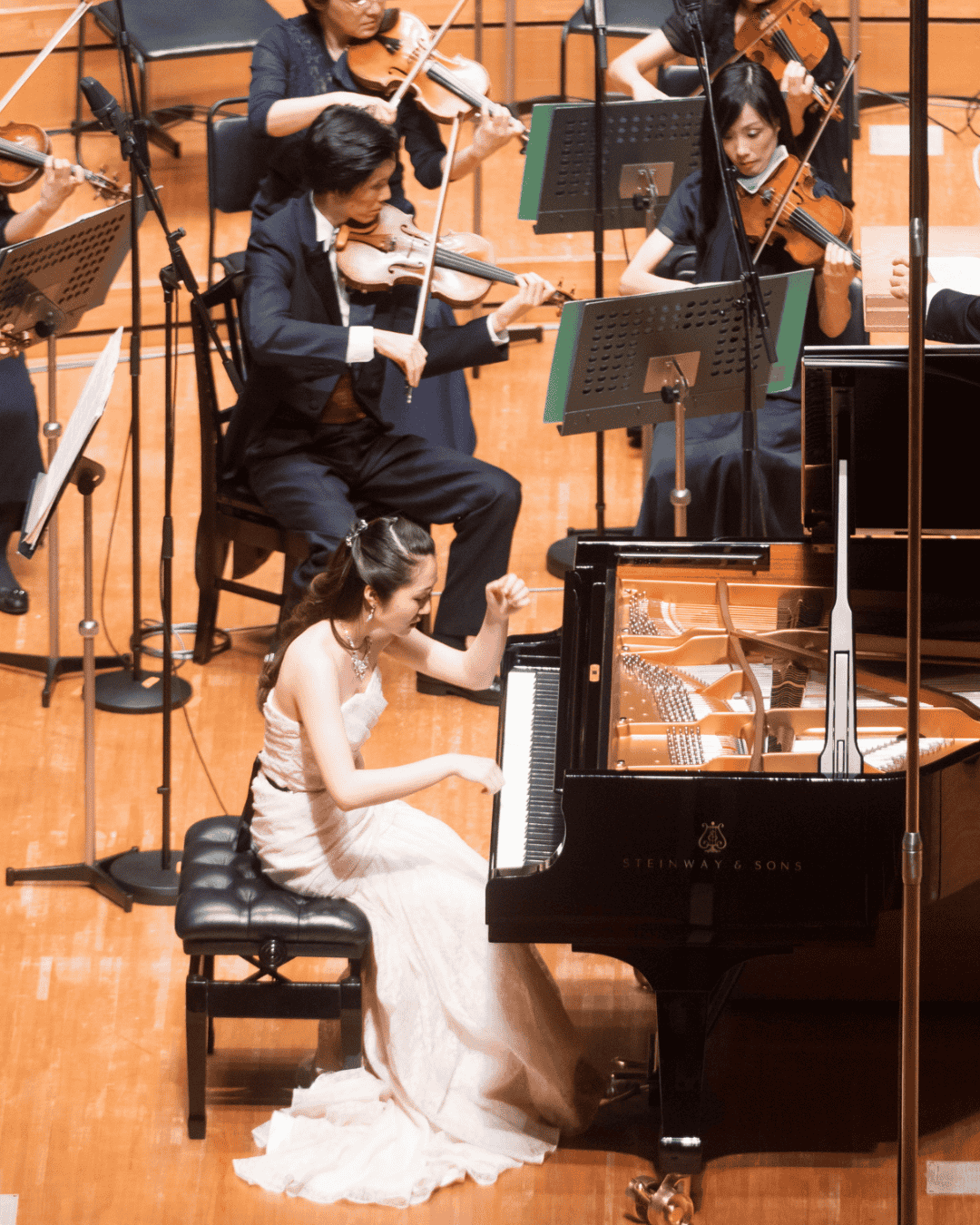
Born in Tokyo in 1998, Karen Kuronuma earned her piano degree from the Tokyo University of the Arts under the guidance of Chiharu Sakai and Koji Shimoda. She is currently studying at the Paris Conservatory (CNSM) in Reiko Hozu’s class, as well as at the Royal Conservatory of Brussels with Johan Schmidt.
Karen won second prize at the 11th Frédéric Chopin International Piano Competition for Young People in Poland. She was also a finalist at the 15th Ettlingen International Competition for Young Pianists and received the Special Prize in Category G at the PTNA Piano Competition.
After enrolling in the high school division of the Faculty of Music at Tokyo University of the Arts, she won, at the age of 16, the First Prize at the Nomura Academy Award, the Iguchi Aiko Prize, the Music Encouragement Prize, and the NHK Prize at the 68th Japan Music Competition, in the high school division.
She made her debut as a soloist with the Hyogo Performing Arts Center Orchestra, performing Chopin’s Piano Concerto No. 1. She has given recitals in Hokkaido, Tokyo, and Hyogo. In 2018, Karen won the Muza Soloist audition, which led to her performing two years later as a soloist with the Tokyo Symphony Orchestra on *The Masterpiece Classics*. She performed Ravel’s Piano Concerto in G major. As many concerts were canceled or postponed due to the COVID-19 pandemic, The Masterpiece Classics recorded and streamed the concert on Niconico Live. Karen’s performance has been viewed over 10 million times and hailed by the media for the new possibilities it offers for classical concerts today. This recording, titled Live from Muza!, won the Oscar for Best Recording in the Special Category and the Music Pen Club Special Award.
In 2021, Karen Kuronuma began her studies at the Paris Conservatory. That same year, she recorded her first solo piano CD, titled *Les Soirées françaises*, with Live from Muza! She has received widespread acclaim for her interpretations of Maurice Ravel and Francis Poulenc. Karen is regarded as one of the most outstanding pianists of the younger generation.
She won the Dany Pouchucq Scholarship Award at the Ravel Festival in 2020 and the Medal of Honor at the 67th Maria Canals Competition in 2022.
She performs in chamber music recitals and as a soloist in France, the Czech Republic, Belgium, Italy, Spain, and Japan. In 2022, she was selected by the Jeunes Talents association, where she collaborated with pianist Noriko Ogawa, conductors Naoto Otomo, Daisuke Mogi, Kazuyoshi Akiyama, Péter Csaba, violinist Mohamed Hiber, trumpeter Romain Leleu, cellist Peter Maintz, oboist Hans-Jörg Schellenberger, and soprano Juliane Banse. She was selected by the Santander Academy in 2023.
Practical info